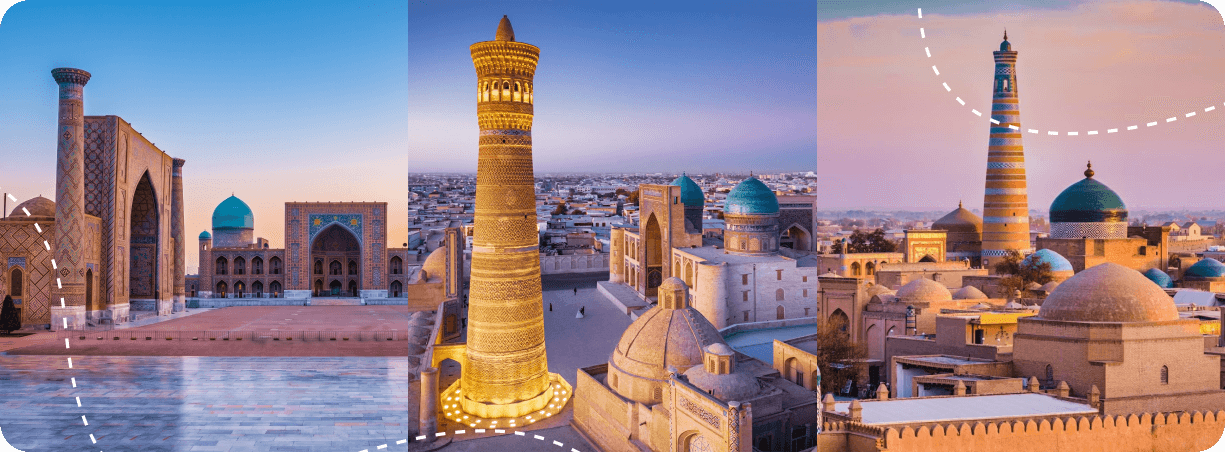
Sometimes it feels as if a real trip has to take you somewhere far away. But in Uzbekistan, it is often enough to take a train, bus or flight — and a few hours later you can find yourself in a city with a different rhythm, different architecture, different plov and even different air.
Domestic travel is not only about a one-day trip to Samarkand. It is also a chance to see the country you live in from a new angle: walk slowly through the old streets of Bukhara, wake up in Khiva near the fortress walls, go to the Fergana Valley for ceramics and silk, discover Karakalpakstan, mountains, desert landscapes and cities that are often left for “someday”.
In the first part, we have put together the cities that are a good place to start exploring Uzbekistan from within. Here you will find famous historic centres, UNESCO World Heritage sites and places you may want to return to again and again. After all, Uzbekistan is like a good book: the more slowly you read it, the more details you notice.
Samarkand
Some cities become the main point of a journey. Others are the reason the journey begins in the first place. Samarkand is one of those cities.
It is often called a city as old as Rome, the capital of the Great Silk Road and a place where the East learned how to amaze through architecture. Do not rush to build a packed itinerary. In Samarkand, it is better to leave time for accidental discoveries: turn into a quiet side street, drink tea in an inner courtyard, stop by Siab Bazaar for fresh Samarkand bread, or simply sit in the evening opposite the illuminated Registan. These are often the moments you remember most.
What to see
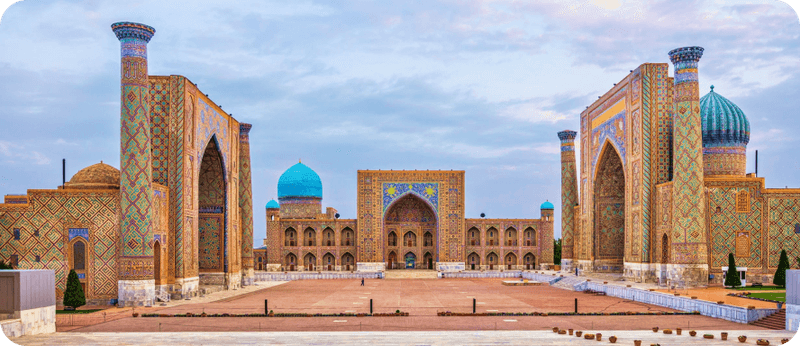
Registan is the heart of Samarkand and probably the most recognisable square in the country.
It is worth coming here twice: in the morning, when there are still fewer tourists, and in the evening, when the madrasahs are beautifully lit.
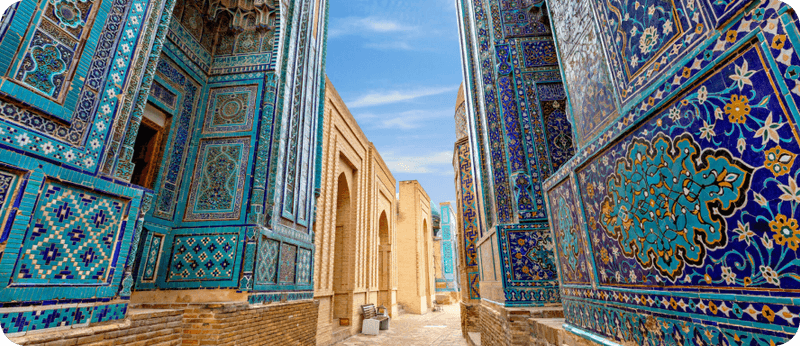
Shah-i-Zinda is one of the most beautiful architectural ensembles in Uzbekistan. It feels almost impossible to find two identical patterns in its turquoise mosaics. According to legend, Qusam ibn Abbas, a cousin of the Prophet Muhammad, is buried here. The name of the complex translates as “The Living King”. According to the story, after receiving a fatal wound, he did not die but disappeared into the underground world. For many centuries, this has made Shah-i-Zinda one of the most revered places in Samarkand.
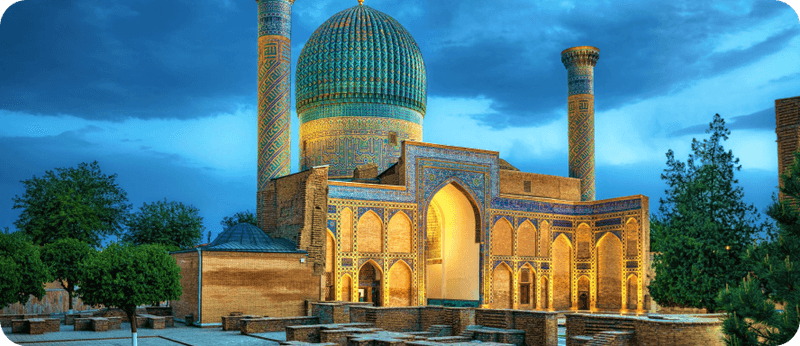
The Gur-e-Amir Mausoleum is the resting place of the great commander Amir Temur and one of the main symbols of Samarkand. This is where the founder of a vast empire stretching from India to the Mediterranean was laid to rest. According to legend, a warning was carved on his tombstone: “Whoever disturbs my peace will release a conqueror more terrible than me.”
People come to Siab Bazaar not only to shop. It is a chance to see everyday Samarkand, try local sweets, dried fruits and the famous Samarkand bread.
What to try
If you ask people from Samarkand what makes their city different from others, many will mention bread before Registan. Samarkand bread is famous far beyond the country. Thanks to a special baking technique, it stays fresh for a long time. Some travellers even take it home as a food souvenir.
From Samarkand, it is easy to continue your journey. Around an hour and a half by high-speed train — and you arrive in a city where time seems to move more slowly.

Bukhara
If Samarkand impresses you from the first minute, Bukhara does it gradually.
Here, you may not even feel like taking out a map and ticking off sights. It is much more interesting simply to walk ahead, turn into narrow streets, look into craft workshops, drink tea in inner courtyards and watch the city live its everyday life. Time seems to move a little more slowly here. Perhaps that is why Bukhara appeals so much to those who are tired of always rushing.
What to see
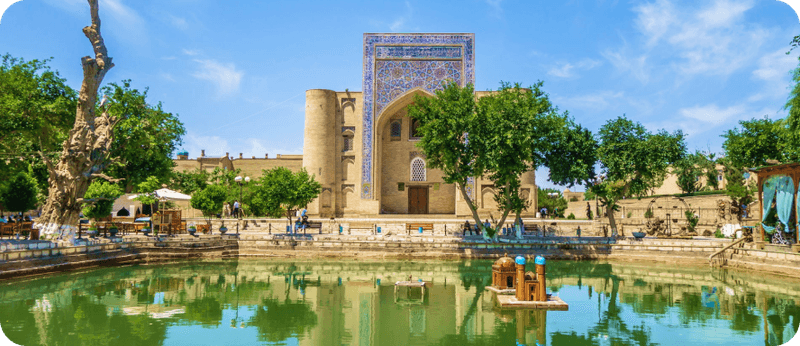
The Lyabi-Hauz complex is the heart of old Bukhara and one of the city’s most atmospheric places.
It formed around an old pond that, centuries ago, was one of the main meeting places for local residents and travellers. Today, historic madrasahs, teahouses and restaurants are located around it, making it a pleasant place to rest after a walk. Lyabi-Hauz is especially beautiful in the evening, when the lights come on and street musicians begin to perform.
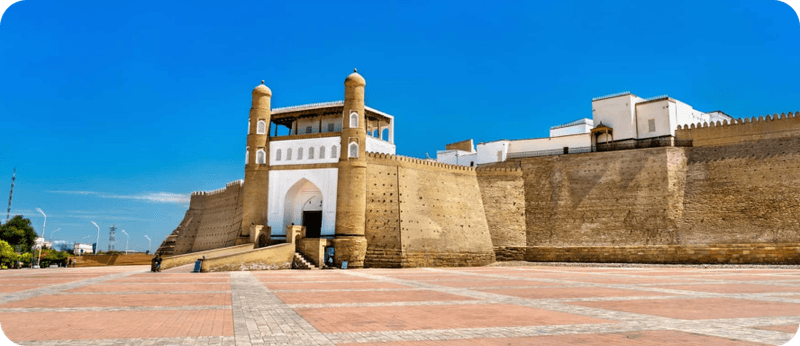
The Ark is one of the oldest fortresses in Central Asia, with a history of more than 1,500 years. It served as the residence of the emirs of Bukhara. Behind its powerful walls were palaces, administrative buildings and service areas.
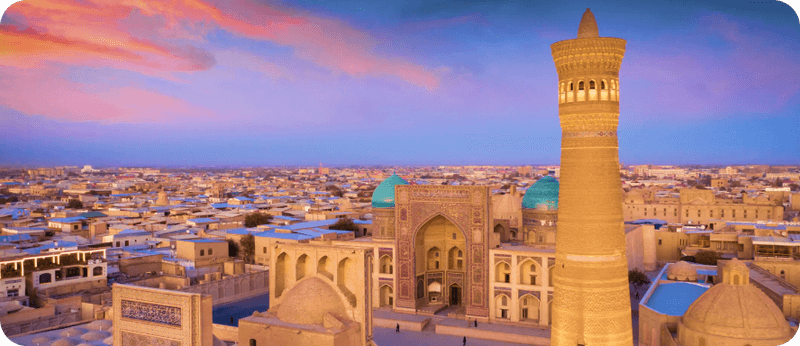
Almost nine centuries ago, the Kalyan Minaret was the tallest structure in Central Asia and served as a landmark for caravans travelling along the Great Silk Road.
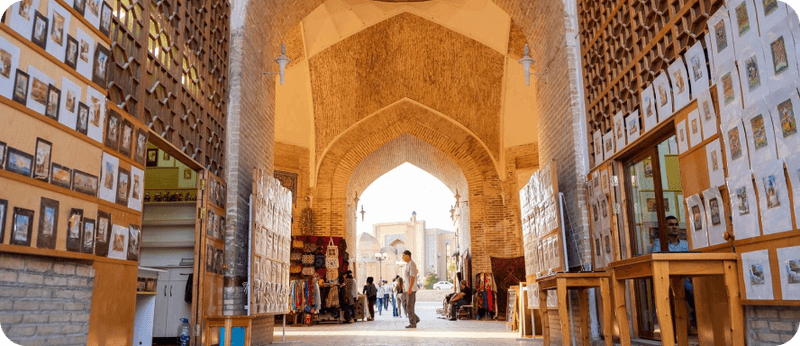
The trading domes are a group of historic markets where you can still buy handmade jewellery, carpets, ceramics, knives and other works by local artisans.
What to try
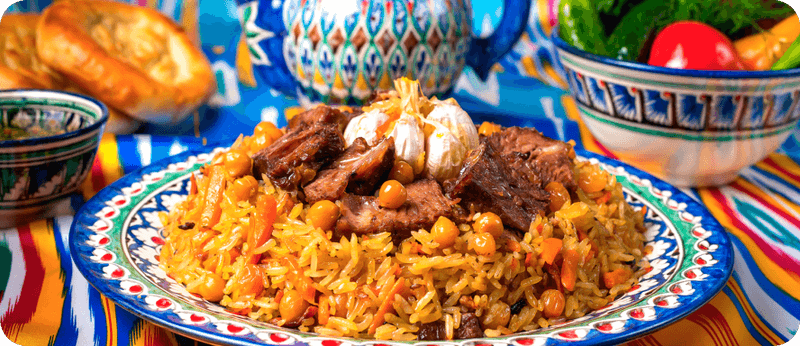
Bukhara is one of the best cities in the country for discovering traditional cuisine. Be sure to try Bukhara plov. It differs from Tashkent and Fergana plov not only in taste, but also in the way it is prepared. Also pay attention to kebab, homemade halva and tea with Eastern sweets in old teahouses.
What to bring back
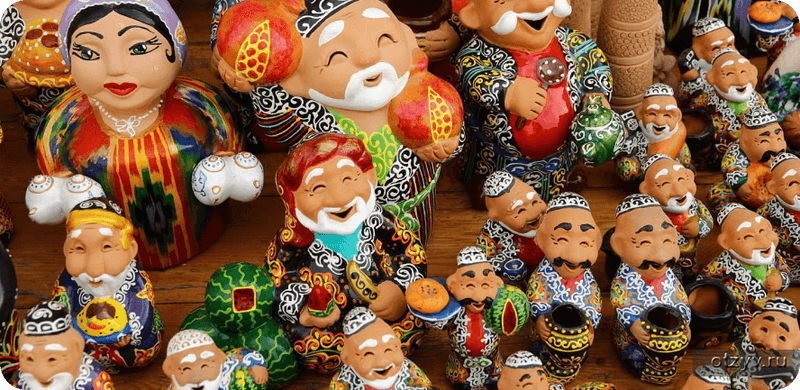
Bukhara is a real paradise for lovers of handmade crafts. This is one of the easiest places to find suzani embroidery, silver jewellery, miniatures, carpets and ceramics made by local masters. Many family workshops have been working for several generations and are happy to tell visitors about their craft.
After Bukhara, it may seem hard to be surprised by another ancient city. But once you reach Khiva, you realise that the journey is only just beginning.
Khiva
Some cities look like museums. Khiva is a city that has become an open-air museum. Once you pass through the gates of Itchan Kala, it feels as if time has turned back. There are no modern high-rises, wide avenues or the usual city rush here. Instead, you find clay walls, old madrasahs, narrow streets and dozens of architectural monuments, many of which have been preserved almost as they were several centuries ago. It is no coincidence that many people call Khiva the most cinematic city in Uzbekistan.
What to see
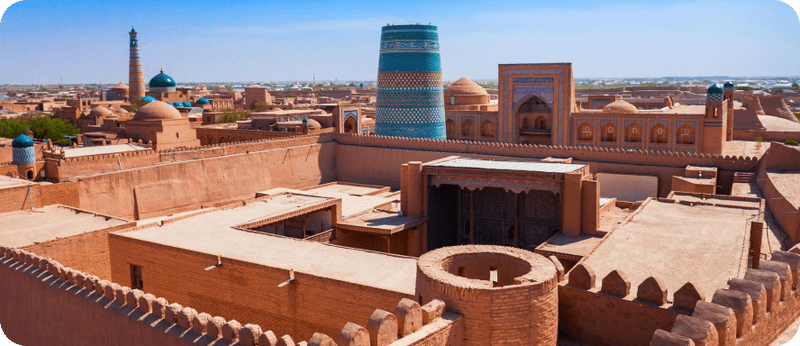
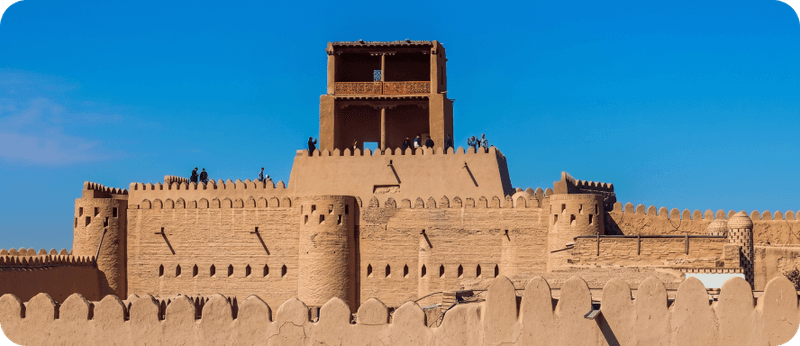
Itchan Kala is the historic centre of Khiva, surrounded by fortress walls up to 10 metres high. It is one of the best-preserved medieval cities in Central Asia, where almost every house, mosque or madrasah is a historic monument. The entire complex is included on the UNESCO World Heritage List.
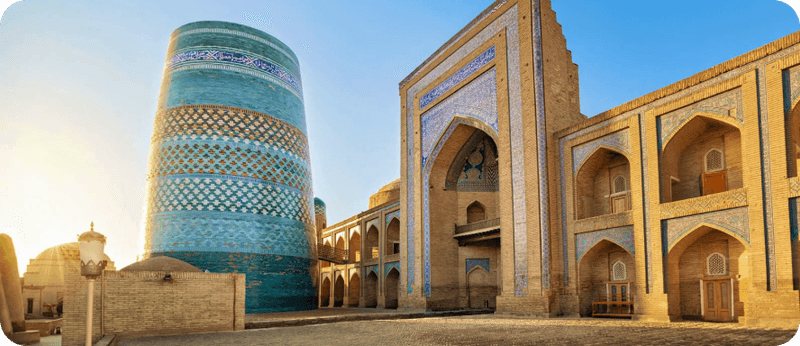
Kalta Minor is one of the symbols of Khiva. It is easy to recognise by its bright turquoise tiles. According to legend, the minaret was meant to become the tallest in Central Asia, but construction was never completed.
Kunya-Ark is the former residence of the Khiva khans. Go up to the viewing platform: from here, you get one of the best views of the old city.
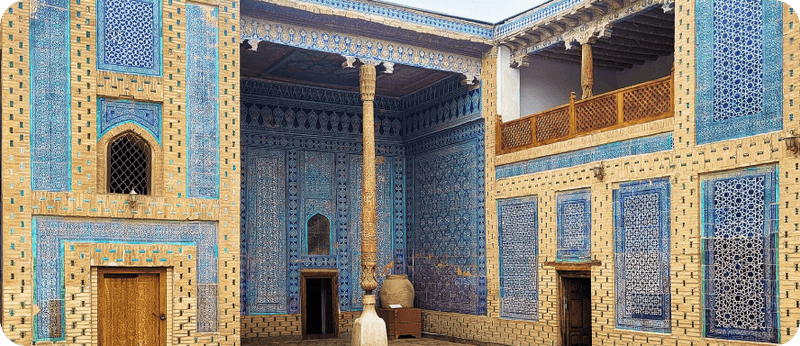
Tash-Hauli is a luxurious 19th-century palace. Its name translates as “Stone Courtyard”, but inside, visitors are not met by severe stone walls. Instead, there are elegant ayvans, carved columns, blue majolica patterns and cosy inner courtyards filled with Eastern atmosphere.
What to try
Khiva is known for a dish that is rarely found in other regions of the country: tukhum-barak. It is made from thin dough with an unusual filling of egg and milk, and is boiled just before serving.
If you want to try something truly local, start with this.
After three ancient cities, it is time to see Uzbekistan from a different angle. If it feels as if the country has already surprised you with ancient cities and Eastern architecture, it is time to go to Nukus. This city is completely different from the usual tourist routes and reveals Uzbekistan from an unexpected side.

How to Plan a Route Around Uzbekistan
You do not need to wait for a long holiday to explore Uzbekistan. Sometimes, a couple of free days are enough for a trip to Samarkand, Bukhara, Khiva or the Chimgan Mountains. High-speed trains run between the country’s major cities, while domestic flights are available for more distant destinations.
For example, many travellers take the Afrosiyob high-speed train from Tashkent to Samarkand or Bukhara. For Nukus or Urgench, it is more convenient to fly and continue the journey from there.
In the ioka app, you can choose your route in advance, compare timetables and buy both flight and train tickets. This allows you to plan the entire journey at once — from the first stop to the last.

You can contact ioka travel support:
Via Telegram — @iokauz_customer_service
By email — support@ioka.uz
By phone: +998 78-113-61-72; +998 91-778-60-40.