
We look at what journalists from Forbes Kazakhstan, Spot, and The Steppe asked our founders — and how ioka travel has changed over the year between these publications.
Over the past year, three in-depth articles about ioka travel have been published, each addressing a different question. Forbes Kazakhstan explored why a Kazakhstani fintech company entered Uzbekistan’s travel market. Spot examined how investors view the region. The Steppe looked at what really goes on behind the scenes when someone books a ticket through an app.
We’ve brought together the key takeaways from all three publications in one article, including the main insights, figures with dates, and links to the original pieces.
Forbes Kazakhstan: Why We Entered Uzbekistan
An interview with Magzhan and Anara Zhumash, October 14, 2025
The article was published two weeks after the platform’s official launch on October 1, 2025. The founders explained why a company that had spent years working in payments decided to enter the travel market.

The original plan was different. The team initially considered launching a payments business in Uzbekistan, but the local e-commerce market had not yet reached the level needed to support a major fintech project. At the same time, according to Magzhan, around 70% of the country’s residents bought tickets and tours offline, while online sales remained a largely untapped market.
A testing period. The service had been operating in test mode since September 2024.
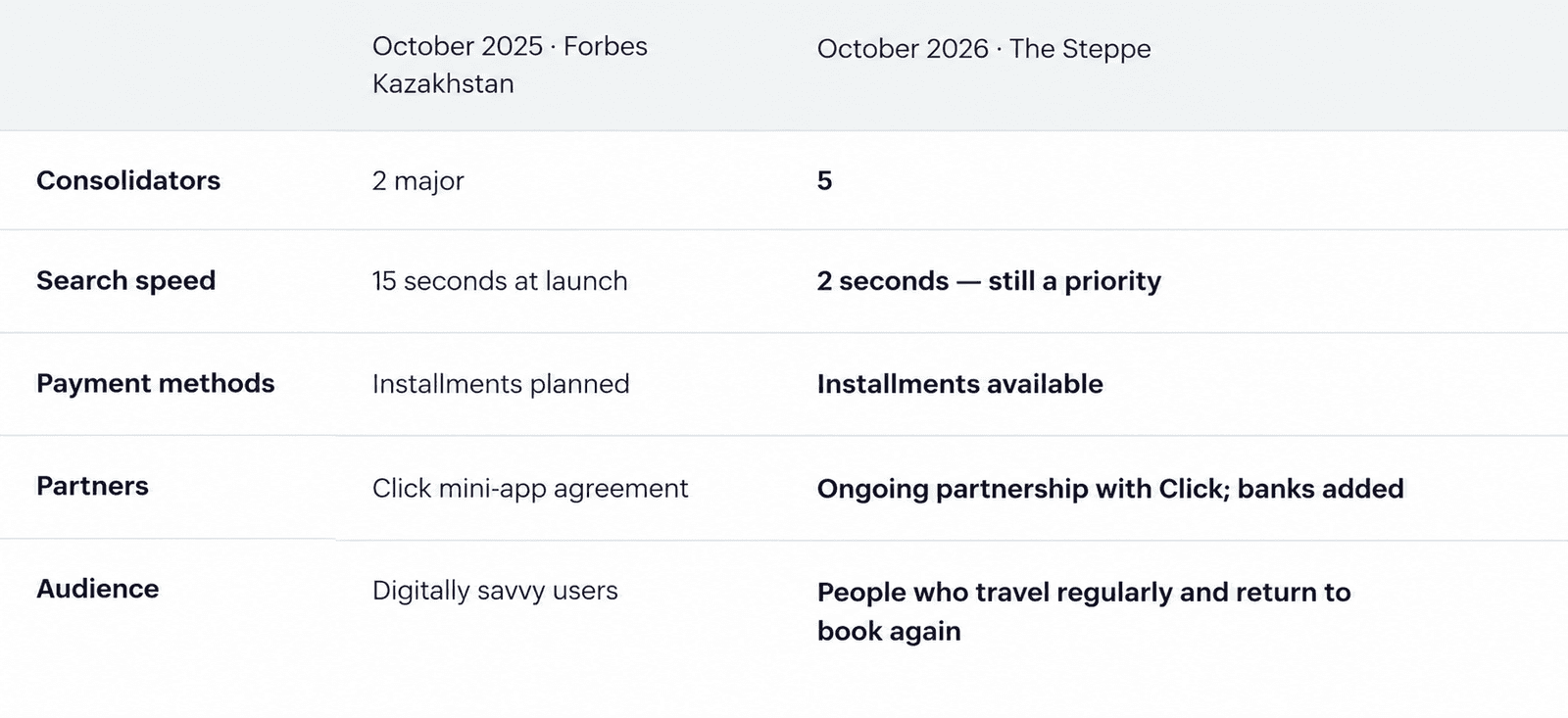
Speed. At launch, ticket searches took around 15 seconds. By the time of the interview, that had dropped to two seconds. A booking could be completed in three clicks.
Three lessons from the market. The first was patience: integrations took longer than expected, and, as Magzhan admitted, “the initial plans were too optimistic.” The second was understanding local business culture: personal contact and informal meetings often matter more than agreements on paper. The third was learning to listen to the market and create value together with users.
Government support. The company became a resident of IT Park Uzbekistan, which helped with recruitment, office space, and other operational matters.
Looking ahead. The founders saw Uzbekistan as a base for expanding into Kazakhstan, Tajikistan, and Kyrgyzstan, with the Middle East as a longer-term opportunity.
Read the interview in Forbes Kazakhstan.
Spot.uz: How to Look at Central Eurasia
Magzhan Zhumash’s speech at CEVF 2026, April 27, 2026. The article was published as sponsored content.
At the Central Eurasian Venture Forum in Tashkent, the ioka travel team took part in Startup Alley, while Magzhan joined a panel discussion on access to funding. His main point was that investment decisions are shaped not by the amount of capital available, but by how mature the market is and how well investors understand it.
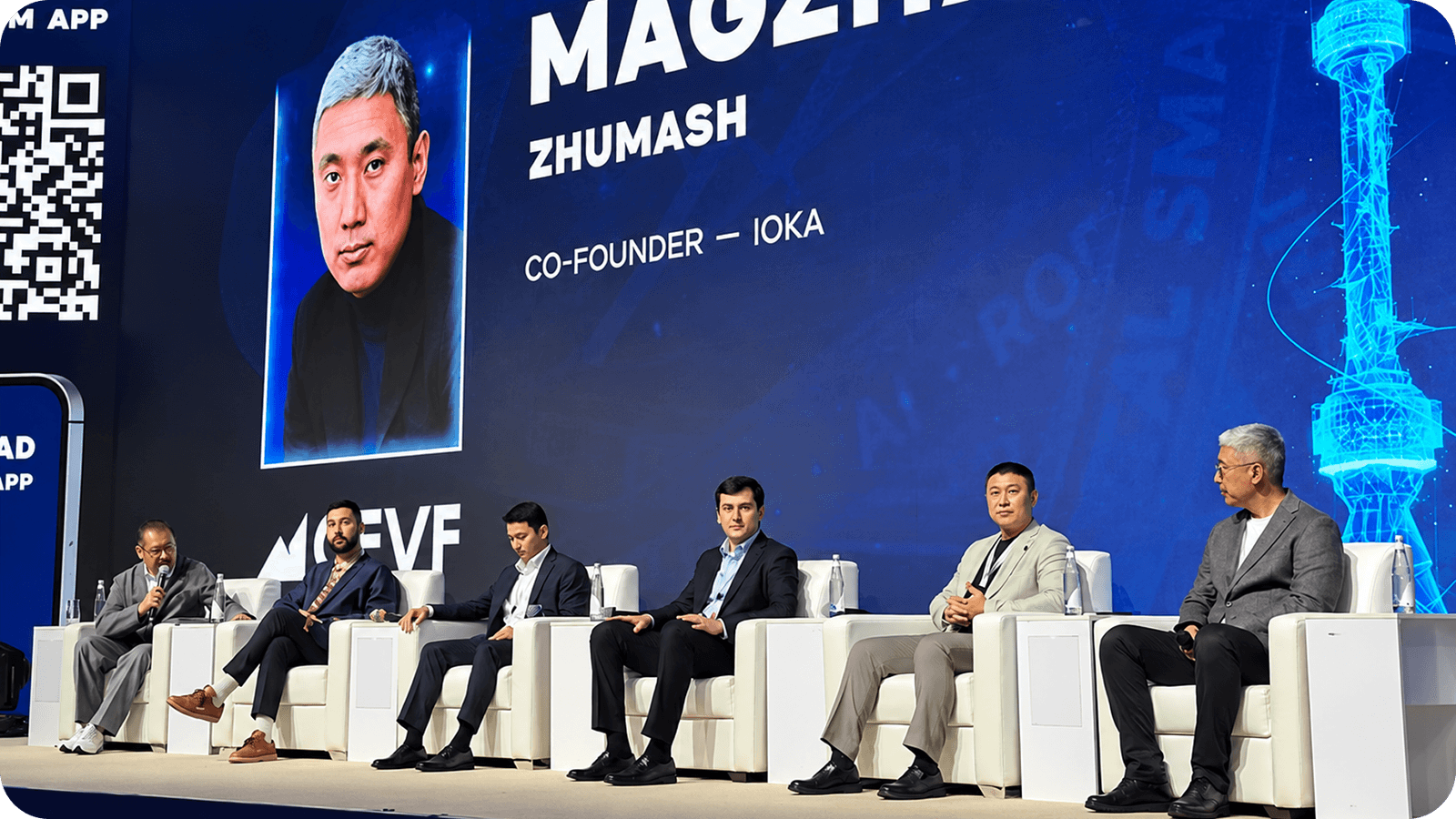
He outlined three shifts he believes investors in the region need to make:
- From local markets to a regional perspective. Strong Central Asian teams build their businesses with several countries in mind from the outset. Evaluating them solely on demand within a single country can therefore underestimate their potential.
- Looking beyond venture capital. Private businesses can play an important role. A strategic partner brings more than money: it can provide a customer base, distribution channels, and clear performance metrics.
- Betting on teams. In a rapidly changing region, the ability to learn quickly and make decisions under uncertainty is what makes the difference.
Magzhan also compared two markets. Kazakhstan has a more mature ecosystem, with established structures and accumulated experience, while Uzbekistan is developing faster and offers more room for new players.
His overall conclusion was that the region should not be seen as a collection of individual startups, but as an emerging platform.
If you’re interested in this topic, our blog features an article on how Central Eurasia’s investment landscape is changing and what this means for businesses, consumers, and the regional economy.
The Steppe: How Travel Tech Works Behind the Scenes
“Three Years in Travel Tech: 5 Myths About the Travel Business,” October 21, 2026
The Steppe spoke with Anara and Magzhan Zhumash to examine five common myths about travel tech. Here are the key takeaways.

1. “All you need is a user-friendly app.”
Behind a ticket purchase that takes just a couple of minutes lies a substantial amount of technological work: more than $1 million invested over three years, integrations with five major ticket consolidators, and approximately seven tour operators.
Travelers don’t see this complexity. They see a clear price and a successful payment.
Available payment methods include UZCARD, HUMO, Visa, Mastercard, Click, Payme, Uzum, and installment payments.
2. “You can’t grow without a big advertising budget.”
Within the first year after launch, the company reached approximately 2,000 tickets sold per month, largely through organic demand.
The founders highlight three factors that influence a purchase: a wide selection, competitive pricing, and post-purchase service.
Another lesson was that “you can’t build a product for everyone.” The team focuses on people who travel regularly and value convenience. These customers can also earn 1% back in bonus points on future trips.
3. “A train ticket is the same everywhere.”
The train and route may be the same, but the booking experience can be very different.
With ioka travel, users can book return tickets, purchase tickets for a group at once, save documents and payment methods, fill in passenger details quickly through MyID, and refund tickets online without visiting a ticket office.
According to the founders, 73% of customers who use the railway booking service return to ioka travel.
4. “Travel tech is only for travelers.”
Other companies can also use ready-made travel technology. ioka travel works with Click and banks, and corporate travel is another area of focus.
5. “The work ends once the ticket is sold.”
That is when it really begins.
The team aims to respond to customers within five minutes and resolve most requests within fifteen. On one occasion, a passenger was denied boarding because her ticket did not include her patronymic. ioka travel refunded the full ticket price at its own expense.
For the founders, this is a matter of trust — something more important than saving money on a single order.
Read the article on The Steppe.
What This Means for Businesses
The fourth myth deserves a closer look: business travel also requires a system.
When trips are organized manually, time is wasted and responsibilities become unclear. ioka travel’s corporate account brings the entire process together in one place.
Roles and access. You decide who can book tickets, who oversees the budget, and who only needs access to reports.
Passenger database. Employees’ passport details are stored in one place, so there is no need to request them for every trip, reducing the risk of errors in travel documents.
Orders and history. All air and rail tickets, along with tours, appear in the orders section, with their statuses and the option to book again.
Finances. Balances, top-ups, debits, and refunds are collected in one section, making it easier to reconcile transactions and analyze expenses.
Company details. Your company’s billing details are automatically added to documents.
Getting started takes just a few minutes. On ioka.uz, select the “For Business” account type, enter your email address, company details, and tax identification number, accept the terms of the offer, and confirm your registration using the code sent by email.
A step-by-step guide is available in our article, “ioka travel for Business: Automation, Control, and Transparency.”
What Changed Over the Year
What All Three Articles Have in Common
Three publications, three formats, and three different sets of questions — yet several themes appear throughout all of them.
Trust. Distrust of online purchases has been and remains a major barrier. Transparent pricing and fast customer support help overcome it.
Technology behind the scenes. Search speed, integrations, and payment systems may be invisible to users, but they shape the overall experience.
Partnerships. Super-apps and banks make it possible to integrate travel services into the digital environments people already use.
Human connection. Communication with customers and partners still matters enormously, particularly in Uzbekistan.
The region. Uzbekistan is our base, while our broader goal is to build a connected travel ecosystem across Central Asia. Anara describes this idea as a “Central Asian Schengen” in a digital sense.
What’s Next
We’re grateful to the publications that tell our story, and we’ll continue sharing new coverage as it comes out.
In the meantime, if you’re ready to experience the service for yourself, you can search for tickets on ioka.uz or in the app.
ioka travel. Exploring the world together!
Contact details
Phone: +998 78 113 6172; +998 91 778 6040.
Email: sales@ioka.uz
Telegram: @iokauz_customer_service